

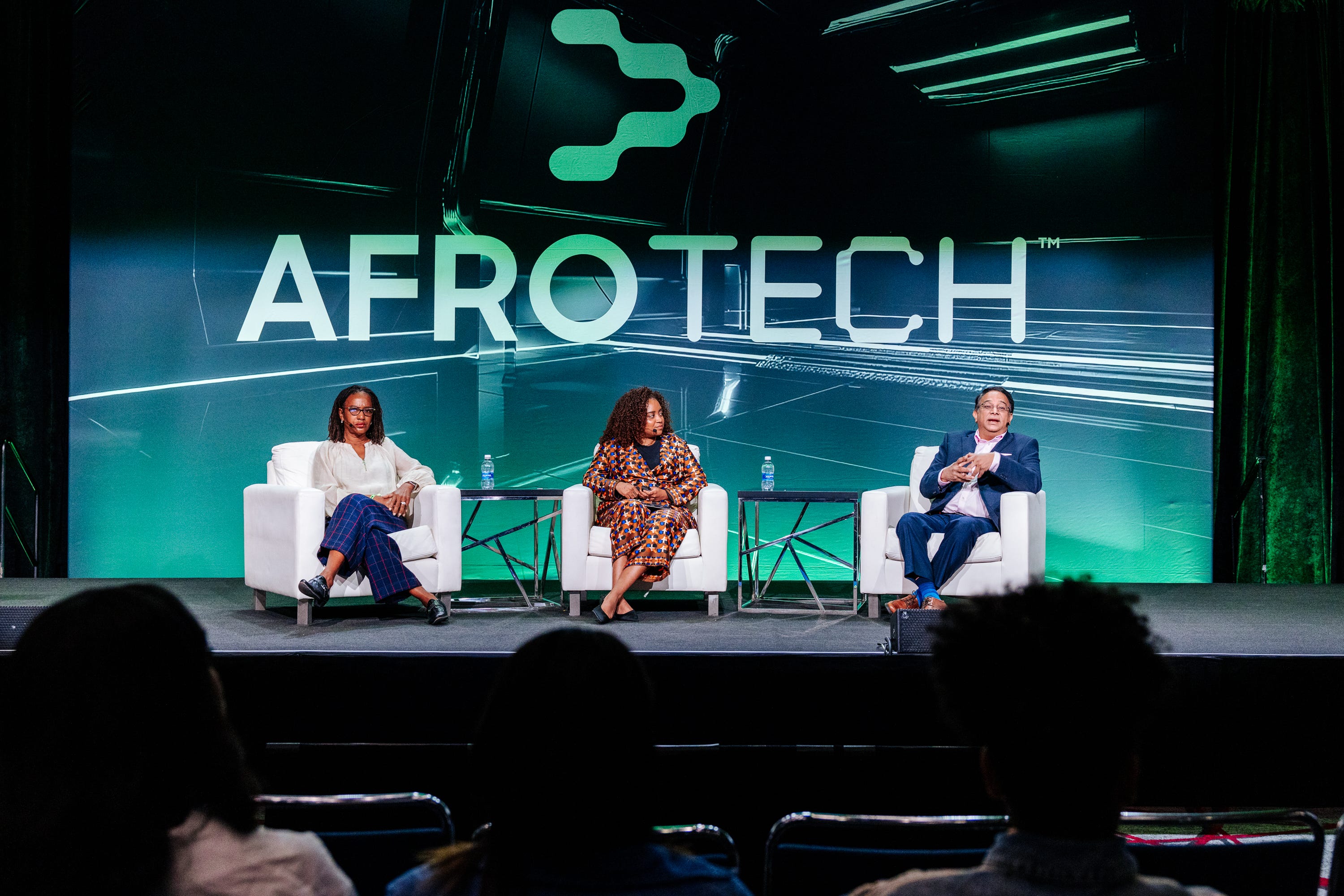
Building software has become the easy part of AI. Over two days at AFROTECH in Houston, three guests showed us what has become hard instead.
The conference turned ten this year, and we flew in from Sydney to be there. We sat down with Dr Olukunle Owolabi of Meta AI, Esosa Osa, founder and CEO of Onyx Impact, and Nicole Dove, a cybersecurity leader at Frame Security. Different fields, same conclusion: the scarce skill is no longer producing technology. It’s judging it.
We’re not the only ones finding this. RAND’s 2024 study of AI project failure reports that, by some estimates, more than 80% of AI projects fail, twice the rate of IT projects without AI. After interviewing 65 data scientists and engineers, its researchers found the first root cause wasn’t the technology. It was stakeholders misunderstanding, or miscommunicating, the problem AI was meant to solve.
The Conventional Wisdom
The default assumption is that building is the bottleneck. Engineers, time and budget decide what gets made, so whoever builds fastest wins.
AI is loosening that bottleneck. Olukunle put it plainly:
you no longer need a team of around 20 people to build something, and you can do it in a day, two days or over a weekend.
AI coding assistants now complete tasks that used to take developers far longer. Teams want to experiment. Businesses want to show progress in a market that keeps moving. It’s a comfortable story, because it makes speed the whole game.
Why It’s Incomplete
Olukunle told us about an application he built to help himself practise coding problems. He had the skills, and the idea seemed useful. He told us how it went:
“I built a product … in a weekend for myself and it wasn’t useful. I didn’t use it.”
Even as the intended user, he hadn’t pinned down what it needed to solve.
His reasoning: if he couldn’t nail it for himself, it gets harder still for companies building for millions of people, with a budget, a deadline and a board watching. The excitement of building crowds out the original problem, and the product ships anyway. That is the pattern behind RAND’s first root cause.
Faster building doesn’t fix a fuzzy problem. It gets you to the wrong answer sooner.
The New Frame
If building is cheap, the work moves to three judgement calls: what to build, who it’s for, and whether it’s safe. Each of our guests took one.
Decide what to build
Olukunle’s checklist for AI products has four parts: understanding user needs, establishing trust, evaluating how the system performs, and keeping a human in the loop, with a kill switch and someone there to make the calls. He also pushed back on feature sprawl:
“My problem is that we’re seeing a lot of speed, but we’re not nailing it.”
His advice was to start with a few core features and nail them.
None of this is glamorous. Requirements gathering, stakeholder input and defining a successful outcome are old disciplines. When AI speeds up development, the risk is treating them as obstacles instead of foundations.
Decide who it’s for
AiSHA started as a fairly small feature within Onyx Impact’s Digital Green Book, built to help Black communities navigate misinformation and online harms. Then people began using it for far more than fact-checking. They were asking for oxtail recipes. The team listened, and found a wider need.
Esosa didn’t begin as an AI engineer. Her background is civic engagement, research and information integrity, and she thinks that matters. She told us people tend to assume AI has to be built by an AI engineer. Her answer:
“The reality is most of the time when you are trying to build something that is supposed to be fit for purpose, you need somebody who’s within that context.”
Her team identified the Black journalism, media and research the system should draw on, and Onyx Impact’s researchers tested it against misinformation narratives, bias and stereotypes. That is expertise well beyond software engineering, and it shaped the product.
Her sharpest point: AiSHA centres Black communities but isn’t only for them. Her reasoning runs through history:
“That’s what we know throughout history: when you build things for the folks that it has served most poorly, you build a better system for everyone.”
To us, that makes inclusion a foundation decision, not a patch after launch.
Decide whether it’s safe
Nicole doesn’t see AI replacing the risks security teams already manage. Attackers still exploit identity, data, governance and human behaviour. What changes is speed, scale and sophistication. Phishing shows it: messages that once gave themselves away with grammar mistakes now arrive in convincing language with context. Same attack, better execution.
Code follows the same pattern. AI-generated output can look convincing without being properly validated, and overconfidence is the first risk Nicole named: without a human in the loop checking and validating, confidence gets mistaken for trust. The second is scale. In her words:
“Developers are 10xing their productivity. But are we 10xing the security that aligns with the software development lifecycle? I don’t think so.”
Her answer isn’t to avoid AI coding assistants. It’s to keep doing threat modelling, security reviews, code scanning and human validation. On the skills teams need, she said:
“Before, coding was the skill. Right now that’s not necessarily the skill. It’s the checking. It’s the validation.”
Olukunle sees the same shift from the product side: software engineers evolving into AI product engineers who own the whole loop of building, evaluating and delivering. His reasoning: because building is cheap, one person can own it end to end, but that person has to be a steward.
What This Means For Australians
In Australia versus Big Tech w/ Dave Lemphers, we explored why building Australian AI capability matters. Houston added a harder question. Owning the infrastructure doesn’t settle whose needs the systems represent, how they’re evaluated or who is accountable when they fail.
For a multicultural country like Australia, those aren’t side issues. Not every answer from the US will translate directly, but hearing how a different ecosystem works challenges what we assume about how technology should be built.
More from our AFROTECH conversations
We’ll be sharing highlights from our conversations with:
Dr Olukunle Owolabi, Meta AI: why understanding user needs matters as AI makes building software faster and easier
Esosa Osa, Onyx Impact: the story behind AiSHA and the role of community understanding in developing more inclusive AI
Nicole Dove, Frame Security: what AI-assisted coding means for cybersecurity, developers and the future of engineering skills
📬 Subscribe on Substack for episode breakdowns and behind-the-scenes thinking.
Question for readers
We’d love to hear your perspective: As AI becomes easier to build with, what do you think technology teams need to get better at?
Sources: RAND, “The Root Causes of Failure for Artificial Intelligence Projects and How They Can Succeed” (August 2024). Our conversations with Dr Olukunle Owolabi, Esosa Osa and Nicole Dove at AFROTECH 2026, Houston, Texas.