


Artificial intelligence is no longer a future concept.
It is already embedded in the tools we use every day — from Generative AI writing assistants to systems that automate decisions across organisations.
On the surface, it feels like AI adoption is accelerating rapidly.
But when you look closer at what’s actually happening inside organisations across Australia, the reality is far less mature.
“I think it’s still pretty nascent… many sectors are really trying to work out what it’s going to mean for their business.”
Despite the noise, most organisations are still trying to answer a basic question:
What does AI actually mean for us?
About the Guest
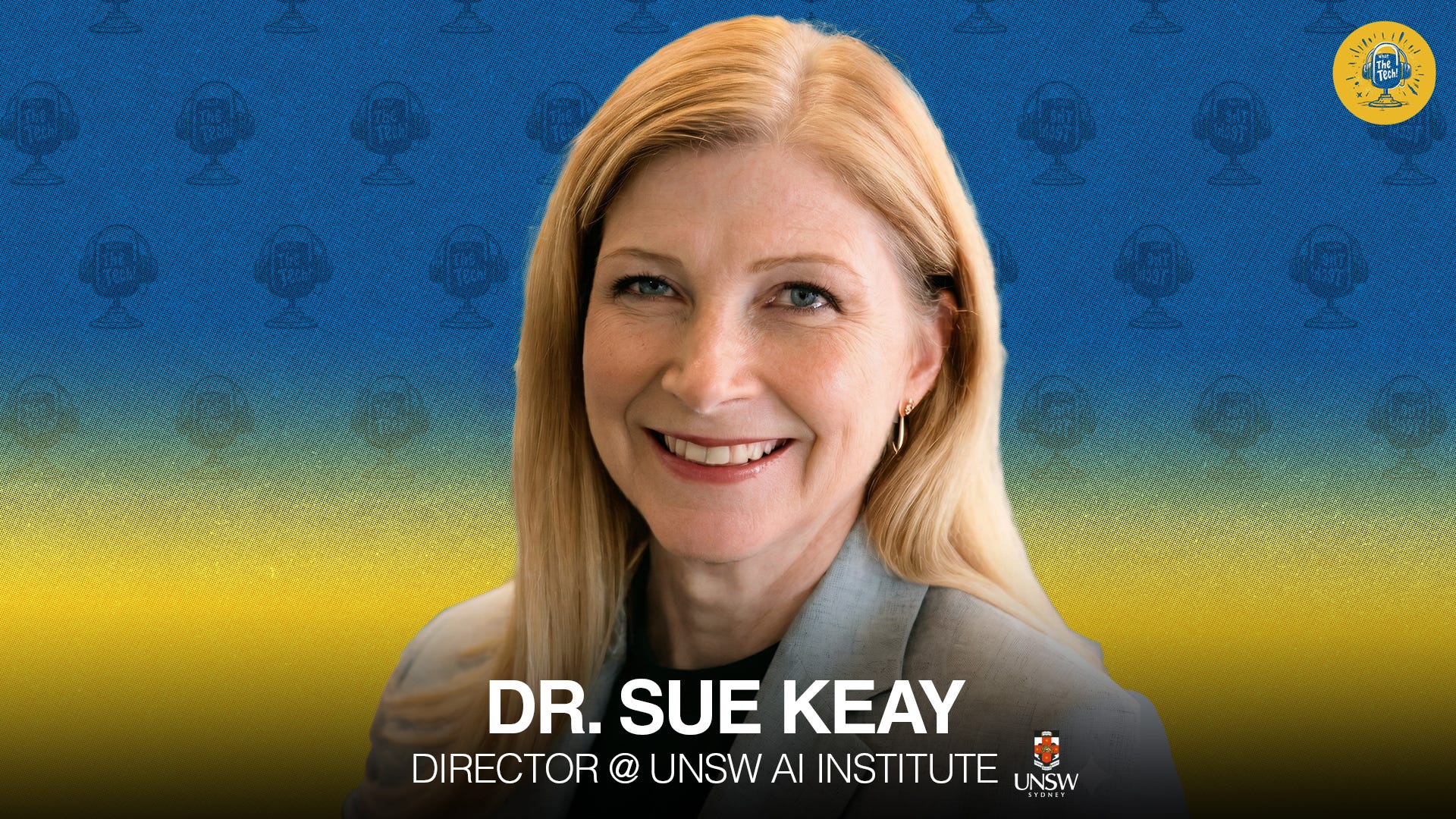
In this episode, we are joined by Dr Sue Keay, Director of the UNSW AI Institute and Founder of the Robotics Australia Group, who has spent her career operating at the intersection of AI, robotics, and real-world deployment.
Her perspective is not shaped by theory alone, but by direct experience working across research, industry, and policy, ensuring that artificial intelligence moves beyond conceptual discussions and translates into tangible outcomes within organisations and across the broader economy.
This is not a conversation about what AI could become.
It is a conversation about what AI looks like today on the ground in Australia.
The Gap Between AI Hype and Reality
There is no shortage of AI conversation right now. But inside organisations, that conversation often turns into pressure — pressure to act quickly, without fully understanding the implications.
“People feel that they’re being rushed… and don’t actually have the tools to assess what AI is going to mean for their business.”
This creates a dangerous dynamic:
High urgency
Low clarity
Unclear ROI
And in that environment, activity is often mistaken for progress.
Why Most AI Projects Stall
One of the most important insights from our conversation is that successful AI adoption is not primarily a technical problem.
It is an organisational one.
“If the CEO and the board are not behind AI, then just forget it.”
The organisations that are able to move beyond pilots and deliver meaningful outcomes are not necessarily those with the most advanced tools, but those with:
Clear leadership alignment
Strong decision-making structures
A deep understanding of their internal processes
And a willingness to experiment while accepting failure as part of the process
Because ultimately, AI does not operate in isolation.
It interacts directly with how an organisation already functions.
“If you don’t understand how you are making those underlying decisions… you’re just working in the dark.”
In that sense, artificial intelligence acts less as a solution and more as a mirror, exposing inefficiencies, gaps in accountability, and weaknesses in data and process maturity.
The Rise of AI Enablement
As organisations begin to recognise that AI is not simply a tool to deploy but a capability to build, a new type of role is emerging: AI enablement.
This is not about adding more engineers or relying solely on external consultants.
It is about embedding expertise within the organisation — individuals who can translate AI capabilities into real business impact.
“Having someone in-house… who can advise people… what these AI tools are useful for… what are the pitfalls… is really important.”
These roles serve as a bridge between technology and operations, helping teams understand not only how to use AI, but when to use it, where it adds value, and where it introduces risk.
Because adoption does not happen at the strategy level.
It happens in the day-to-day decisions made across teams.
The Real Asset: Data
If AI is the engine, then data is the fuel.
And yet, one of the most consistent challenges across industries is that organisations do not fully understand the value of the data they possess — or worse, they have already given it away.
“We’ve been conditioned to accept that we should give up our data for convenience.”
Across sectors such as mining, agriculture, and enterprise software, organisations have historically outsourced data collection and analysis, often through contracts that transfer ownership or control to third parties.
What seemed efficient at the time has now created a structural disadvantage.
Because in the age of AI, data is not just an asset — it is the foundation of competitive advantage.
And losing control of that data means losing control of future value.
The Problem with “AI Washing”
At the same time, the rapid rise of Generative AI has created a new challenge: the tendency to equate all AI with a single category of tools.
“When people think of artificial intelligence, they think exclusively about generative AI… and it’s possibly not the one that’s going to give you the most productivity benefits.”
This has led to what can only be described as AI washing, where products and strategies are rebranded to appear AI-driven without fundamentally changing how value is created.
The risk here is not just misplaced investment. It is a misunderstanding of what AI actually is.
Because while Generative AI is highly visible and accessible, the deeper impact of AI often lies in less visible systems:
Decision optimisation
Process automation
Predictive modelling
Robotics and physical AI
Focusing only on the surface layer limits the potential of what AI can deliver.
Why This Matters Now
We are moving into a phase where AI is no longer optional.
It is becoming part of the underlying infrastructure of how organisations operate and how economies compete.
The real divide is no longer between those who are experimenting with AI and those who are not.
It is between those who:
Understand their systems and data
Invest in long-term capability
Build internal expertise
And those who:
Rely on external solutions
Chase trends without strategy
And underestimate the complexity of implementation
Listen to the Full Episode
In this episode of What The Tech (AU), we explore:
What AI adoption actually looks like in Australia
Why organisations struggle to move beyond pilots
The rise of AI enablement roles
The importance of data ownership
🎧 Listen now on:
📬 You can also subscribe here on Substack for episode breakdowns, reflections, and behind-the-scenes thinking.
Question for readers
If AI is exposing how your organisation really works —
Are you ready for what it reveals?