

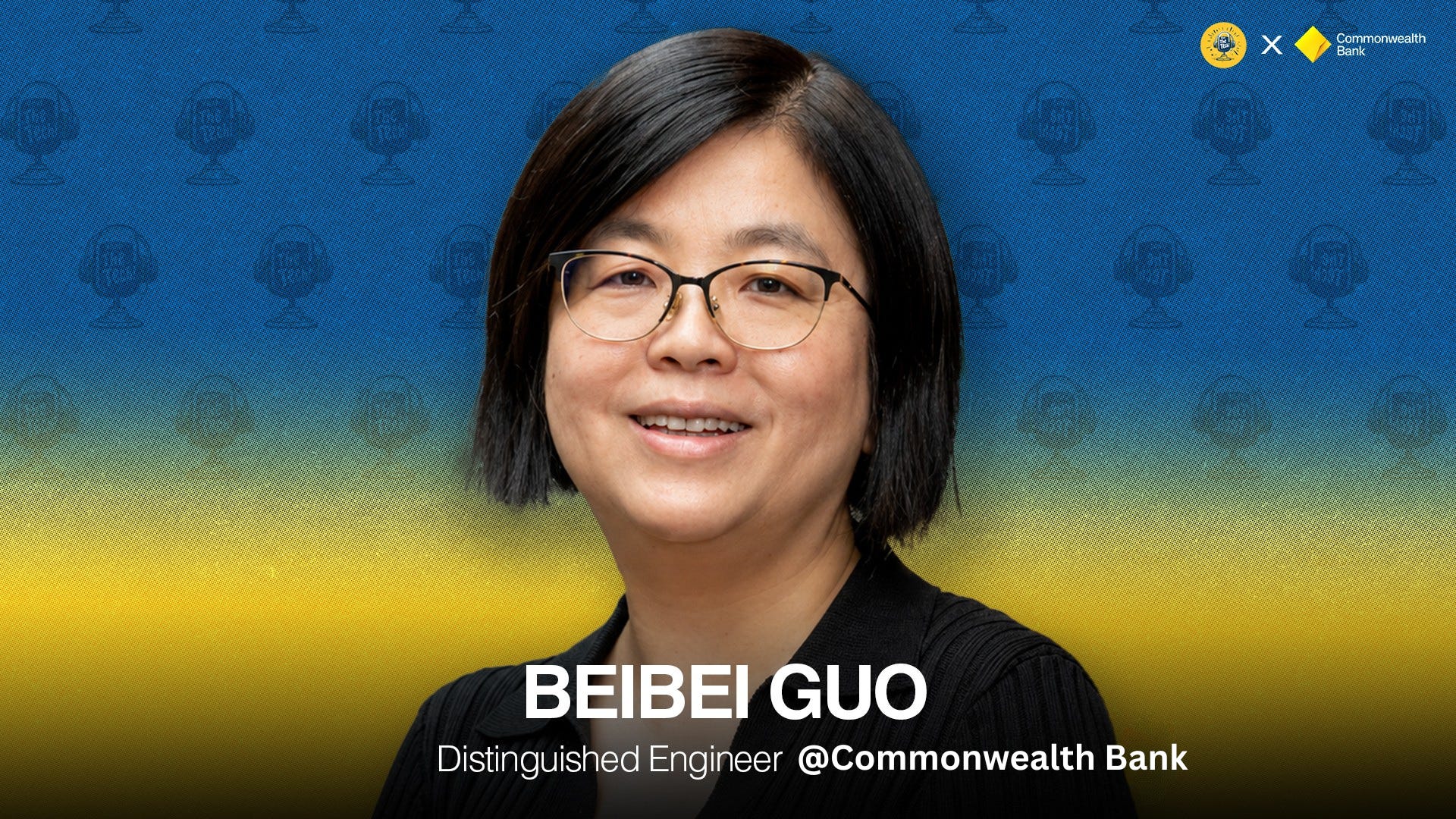
This is a #paidpartnership with Commonwealth Bank.
Inside Commonwealth Bank, engineers can access a sanctioned AI key through a single internal page.
Beibei Guo will tell you that was the easy part.
The demo is never the hard part. The hard part is everything after: the testing, the data, the judgment calls and the unglamorous engineering that turns a hackathon win into something millions of customers can safely touch.
This episode is the clearest look we've had at what AI adoption actually looks like at scale in Australia, not the pitch, the practice.
About the Guest
Beibei Guo is a Distinguished Engineer at CommBank where she has spent more than two decades building large-scale systems and the data platforms that now sit underneath the bank’s AI work.
She has lived through several technology waves, the internet, virtualisation, cloud and treats AI as the next one in that lineage: fundamental but not magic. Her framing is refreshingly unromantic.
“Elapsed time alone is not an asset it’s a data point.”
This isn’t a conversation about distant AI futures. It’s about what AI already looks like inside a major organisation on a normal weekday.
Everyone Got an API Key. That Was the Easy Part.
Beibei describes a single internal page: this is where you get your key, these are the models you can talk to and a banner setting the data classification you’re cleared to use.
The amount of engineering behind that one page was not small.
That’s the gap most AI conversations skip. Getting a demo running is trivial now, give anyone a model and 24 hours and they’ll show you something. Getting that same capability to thousands of engineers, safely, inside a regulated bank, is a different category of problem.
The cycles all look the same, she says: first chatbot, first lab model, everyone vibe-coding their own little tools, then the discovery that vibe-coding alone doesn’t ship. What separates organisations isn’t who runs the hackathon. It’s how fast that energy turns into something enduring that actually creates business value.
She credits the engineers who built the foundations underneath it all:
“the brightest minds and the steadiest hands.”
When Shipping Late Is the Right Call
One story stuck with us.
A rollout was ready. Beibei’s team delayed it by roughly three months to test against a much larger dataset first. More time, more cost, a missed deadline.
Why? Because shipping early on the smaller dataset made the odds of a bad outcome reaching a customer unfiltered an order of magnitude higher.
That’s the kind of call that doesn’t show up in a demo. Someone has to carry the weight of it, with no formula that tells you you’re right.
It’s also why she reframes the usual debate. Not hype versus reality. Hype versus progress. Reality can be bad; progress is the part worth chasing, and you can only tell the difference once you’ve lived through a few landings.
“I became less of a romantic about innovation but more serious about it.”
AI Needs Living Data
One of Beibei’s strongest points is that AI does not become useful just because a model is powerful.
It needs data that is alive.
By that, she does not just mean “clean data.” She means data that carries meaning. Data that is fresh. Data that is trusted. Data that remains consistent as it moves across systems, teams, domains and use cases.
Because in a large organisation, the data you need is often not created by you. It was captured somewhere else, for a different reason, by another system, under another team’s ownership.
If every team has to rediscover what a customer is, what an account is, what a transaction means, or where the freshest version of that data lives, AI does not become intelligence inside the organisation.
It becomes a confident layer on top of confusion.
Good data foundations do not always show up as a feature. They show up as fewer silly questions, less friction, better context, and better customer trust.
An Amplifier and a Mirror
Beibei’s sharpest line about what AI does to a person and a team:
“It’s an amplifier and a mirror. It doesn’t change who you are, it amplifies your impact, in both good and bad ways.”
The good: a colleague who manages IT assets, not a software engineer, needed to understand how thousands of assets connected. Three years ago, that’s a static spreadsheet. Now he built a live, switchable view: Venn, Gantt, list. He built it with AI, deployed it himself, and used it to make a sharper argument. Same job, amplified.
Her graduate engineers shipped production-grade data-comparison systems across hundreds of terabytes within months. But she’s precise about why it worked:
“We didn’t leave them with just a grad and a prompt.”
It was a few grads, a few models, a principal engineer checking in weekly, and clear ownership: this is yours. The amplification came from the structure around the tool, not the tool alone.
The mirror has a darker side too. Lean on it wrong and you get a sycophantic echo chamber, or a team so dependent that pulling the prompt away is an outage. Her warning to early-career engineers is one every team should hear:
“You answer questions way too quickly, before you learn to ask meaningful questions.”
The Wins You Never Notice
Ask where AI is already delivering for ordinary Australians, and Beibei doesn’t reach for anything flashy. She reaches for the invisible.
Cost Benefit Finder (running since around 2019): machine learning that surfaces government entitlements customers are owed. More than $1 billion in benefits found for customers over its life.
Small-business loans: turnaround on smaller loans moved from overnight to roughly two hours.
Scam protection: name-check and account-check tools plus newer AI that proactively engages scammers directly with voice and messaging.
None of it announces itself as “AI”.
A customer doesn’t think “good data quality.” They just feel understood.
The accountant with a business account and a home loan is not asked a silly question, because the context is already obvious. The customer calling support does not think about machine learning; they just experience a shorter wait time or a better-informed operator.
That is the through-line: the best AI often disappears into the service.
Why This Matters Now
The old divide was between organisations experimenting with AI and those that weren’t. That line is gone!
Everyone is experimenting.
The new divide, on Beibei’s account, is judgment infrastructure: the habits, processes and informed people who can make a good call when the rules do not quite fit.
That is not just a governance problem. It is a capability problem. A leadership problem. A workforce problem.
It is the difference between using AI to make people better and using AI in a way that quietly reduces the person doing the work.
Beibei’s read on Australia is optimistic, but not boosterish. The talent is here. The rooms are here. The opportunity is here to build something the rest of the world may eventually look back on.
But only if we approach it with judgment and care rather than panic.
Listen to the Full Episode
In this episode of What The Tech (AU), we get into:
Why the demo is the easy part and what real AI adoption costs
The judgment call behind shipping late on purpose
Why AI needs living data, not just clean data
AI as an amplifier and a mirror
How to keep graduates learning in an AI-native workplace
The invisible, mundane wins that actually build customer trust
Why long-term AI success depends on judgment infrastructure
🎧 Listen now on:
Question for readers
If everyone in your organisation already has the AI keys: what’s your version of the three-month delay and who’s carrying the weight of that call?